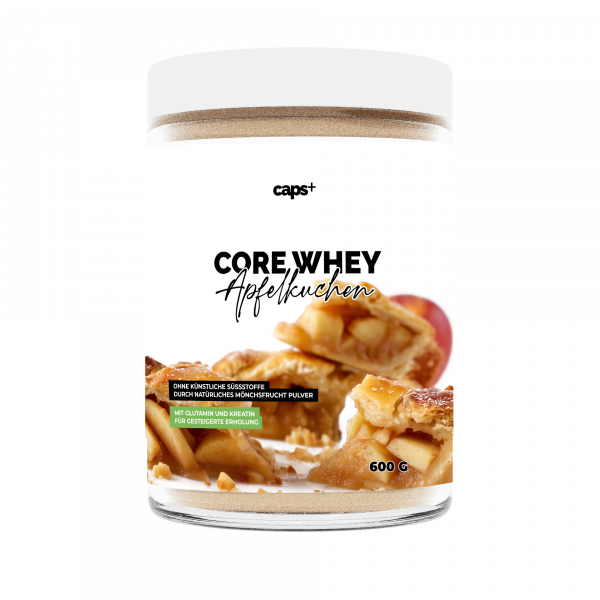
Core Whey
23,95 € inkl. MwSt.46,58 € / 1kg inkl. MwSt. zzgl. Versand
-
Zusätzliche Informationen
-
Wirkung
-
Zutaten
-
Warum Caps+
| Größe | 10 × 15 × 10 cm |
|---|
Wirkung
Zutaten
Zutaten
Molkenprotein Konzentrat, Zuckeraustauschstoff Erythrit, Glutamin, Aroma, Mönchsfrucht Pulver.
|
Nährwerte |
pro 100 g | pro Portion 40 g | pro Portion 40 g mit 300 ml fettarmer Milch |
| Brennwert kJ | 1.632 kJ | 661 kJ | 1.264 kJ |
| Brennwert kcal | 390 kcal | 158 kcal | 302 kcal |
| Protein | 58 g | 29 g | 40 g |
| davon Glutamin | 8 g | 3 g | 3 g |
| Kohlenhydrate | 5 g | 2 g | 18 g |
| davon Zucker | 4 g | 2 g | 18 g |
| Fett | 7 g | 3 g | 7 g |
frei von künstlichen Süßstoffen durch natürlichen Zuckeraustauschstoff Erythrit und Mönchsfrucht Pulver.
Verzehrempfehlung
Rühre eine Portion (40 g) Core Whey in etwa 300 ml fettarme Milch ein. Alternativ können auch Sojamilch, Hafermilch, Wasser oder andere Flüssigkeiten verwendet werden. Genieße deinen Shake morgens, nach dem Training oder als proteinreichen Snack zwischendurch. Für eine cremigere Konsistenz einfach die Flüssigkeitsmenge etwas reduzieren. Beachte: Die tägliche Zufuhr sollte auf höchstens drei Portionen begrenzt werden.
Allgemeine Allergie Infos
Kann Spuren von Gluten, Krebstieren, Eiern, Fisch, Soja, Milch, Schalenfrüchten, Schalentieren sowie Lupine enthalten, da am Produktionsort entsprechende Rohstoffe verarbeitet werden. Sofern nicht anders angegeben: Anteil in % Referenzmenge für die tägliche Zufuhr nach Europäischer Lebensmittelverordnung (LMIV).
Warum Caps+
Caps+ steht für Qualität und Innovation im Bereich Nahrungsergänzung zu fairen Preisen
Hochwertige Inhaltsstoffe: Verwendung von geprüften Rohstoffen ohne unnötige Zusatzstoffe.
Transparente Rezepturen: Klare Angaben zu Inhaltsstoffen und Dosierungen.
Erfahrung als Basis der Entwicklung: Wir verwenden nur Wirkstoffe in unseren Produkten, die sich auch in unserer eigenen Erfahrung bewährt haben.
Herstellung in Deutschland: Unsere Produkte werden unter strenger Qualitätskontrolle von uns selbst hergestellt.
Ganzheitlicher Ansatz: Entwickelt, um deinen Körper rundum mit den besten Nährstoffen zu versorgen.
Kundenorientierung: Basierend auf euren Bedürfnissen und eurem Feedback erweitern wir stets unser Produktsortiment.
Quellen:
(1) Guan et al., Molecules, 2021: Soluble Dietary Fiber, One of the Most Important Nutrients for the Gut Microbiota
https://pubmed.ncbi.nlm.nih.gov/34833893/
(2) Soomro, M.A., Khan, S., Majid, A. et al. Pectin as a biofunctional food: comprehensive overview of its therapeutic effects and antidiabetic-associated mechanisms. Discov Appl Sci 6, 298 (2024). https://doi.org/10.1007/s42452-024-05968-1
(3) Brown L, Rosner B, Willett WW, Sacks FM (1999): Cholesterol-lowering effects of dietary fiber: a meta-analysis.https://pubmed.ncbi.nlm.nih.gov/9925120
(4) Muñoz-Almagro N, Montilla A, Villamiel M. (2021): Role of pectin in the current trends towards low-glycaemic food consumption. https://www.sciencedirect.com/science/article/pii/S0963996920308760
(5) Alaa F. Bakr et. al., 2023: Soluble Dietary Fibers as Antihyperlipidemic Agents: A Comprehensive Review to Maximize Their Health Benefits
https://pubs.acs.org/doi/10.1021/acsomega.3c01121
(6) Legault et al., 2015: The Influence of Oral L-Glutamine Supplementation on Muscle Strength Recovery and Soreness Following Unilateral Knee Extension Eccentric Exercise: https://pubmed.ncbi.nlm.nih.gov/25811544/
(7) Córdova-Martínez et al., 2021: Effect of Glutamine Supplementation on Muscular Damage Biomarkers in Professional Basketball Players. https://pmc.ncbi.nlm.nih.gov/articles/PMC8234492
(8) Kidangathazhe A, Amponsah T, Maji A, Adams S, Chettoor M, Wang X, Scaria J (2025): Synthetic vs. non-synthetic sweeteners: their differential effects on gut microbiome diversity and function. Front Microbiol. https://pubmed.ncbi.nlm.nih.gov/40443994/
(9) van der Hulst, R.R.W.J.; von Meyenfeldt, M.F.; Deutz, N.E.P. et al: The effect of glutamine administration on intestinal glutamine content. In Journal of Surgical Research, Vol. 61, 01.01.1996 https://cris.maastrichtuniversity.nl/en/publications/the-effect-of-glutamine-administration-on-intestinal-glutamine-co
(10) Fernandes MSS, Fidelis DEDS, Aidar FJ, Badicu G, Greco G, Cataldi S, Santos GCJ, de Souza RF, Ardigò LP. Coenzyme Q10 Supplementation in Athletes (2023): A Systematic Review. Nutrients. https://pmc.ncbi.nlm.nih.gov/articles/PMC10535924/
(11) Pereira IC, Sátiro Vieira EE, de Oliveira Torres LR, Carneiro da Silva FC, de Castro E Sousa JM, Torres-Leal FL (2023): Bromelain supplementation and inflammatory markers: A systematic review of clinical trials. https://pubmed.ncbi.nlm.nih.gov/37202035/
Ähnliche Artikel
-
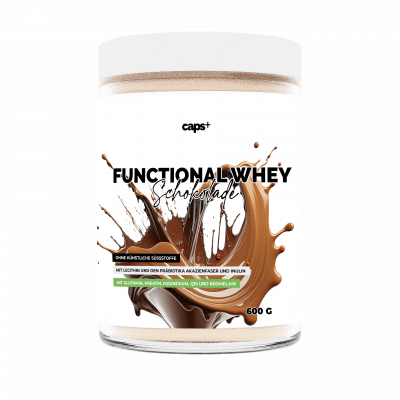
Functional Whey27,95 € inkl. MwSt.46,58 € / 1kg inkl. MwSt. zzgl. Versand
-
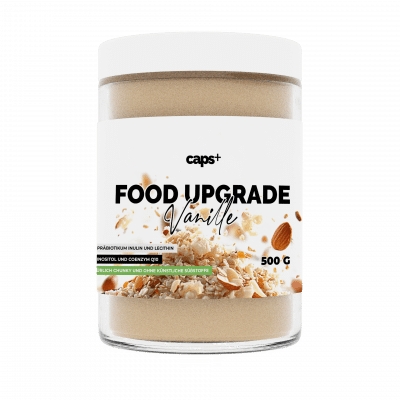
Food Upgrade19,95 € inkl. MwSt.
-
Whey Protein Beutel21,95 € inkl. MwSt. 24,95 € / 1kg inkl. MwSt. zzgl. Versand